

Flow-Formed Wheels: Balancing Strength and Weight
Flow forming is a major breakthrough in wheel manufacturing, striking a clever balance between light weight and high strength. The process starts with a low-pressure cast blank, which is then spun at high speed while hydraulic rollers press the rim. Under combined rotation and pressure, metal grains rearrange circumferentially into dense, forging-like fiber streamlines, raising rim strength by about 30% and allowing wall thickness to be reduced by 15%-20% — optimizing the critical zone while avoiding the high cost of full forging.
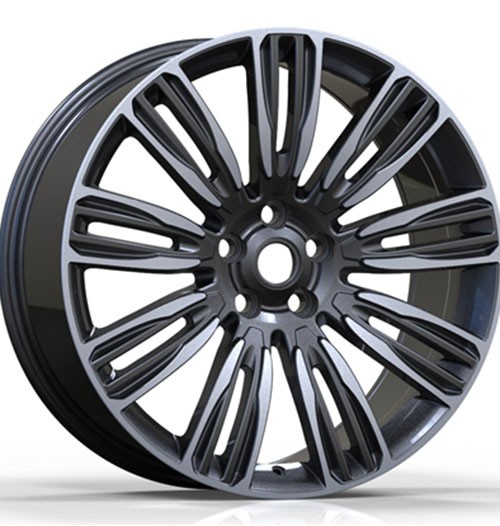
Compared with conventional casting, the elegance of flow forming lies in selective reinforcement: the rim, which bears tire pressure and lateral forces, is strengthened, while the spokes keep the lightness of cast metal. Computer-controlled spin programs vary wall thickness zone by zone — thickening the bead seats for better sealing, thinning unloaded areas to cut weight. The result is a wheel 10%-15% lighter than ordinary cast products with roughly 25% higher dynamic load capacity, well suited to modern cars’ strict unsprung-mass targets.
Economics also explains why flow-formed wheels are spreading fast: only a spinning station is added after the casting line, saving over 60% of manufacturing cost versus full forging. Leading makers have developed double and triple spin-forming, and multi-pass processing now achieves metal elongation above 40%. With advances in aluminum formulations and CNC spin-forming, this process is redefining the performance standard for aluminum alloy wheels.

|
|
Site Navigation
|
WeChat Mall

|
Contact Us
|
|
Copyright Anhui AUHE Technology Co., Ltd. All rights reserved |
|
