

Flow-Forming Wheel Process & Material Properties
Flow forming is an innovative wheel manufacturing process that combines casting with plastic deformation. By spin-rolling the rim section, it rebuilds the metal’s microstructure while shaping it, driving an overall improvement in mechanical properties. For owners who care about aluminum alloy wheel quality, understanding this mechanism helps in judging a product’s true level.
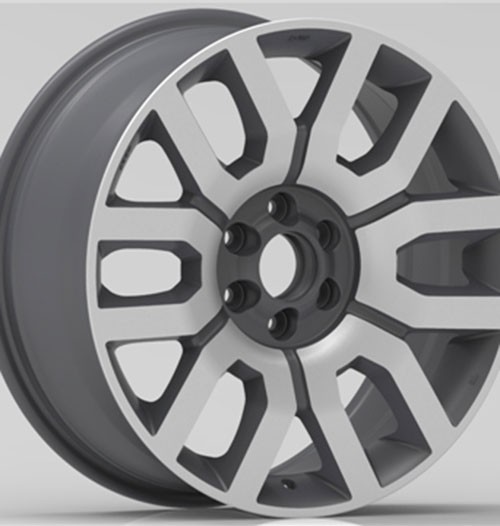
The mechanism works in three main ways. First, grain refinement: coarse cast grains in the blank transform into fine equiaxed grains after severe deformation and dynamic recrystallization — per the Hall-Petch relationship, finer grains mean higher yield strength. Second, densification: shrinkage cavities and porosity left by casting are pressed closed under strong compressive stress, removing fatigue crack initiation sites and markedly extending fatigue life. Third, fiber streamlines: metal aligns circumferentially along the rim, matching the main loads from centrifugal force, bending moments and torque during driving — directional reinforcement exactly where it is needed.
Note that flow forming usually applies only to the rim; the spokes and center disc remain as-cast, so overall performance is a combination of the flow-formed zone and the cast base. Feed rate, roller pressure, spindle speed and temperature must all be precisely controlled: excessive deformation or too low a temperature can cause work hardening and cracks, while too little deformation fails to trigger recrystallization. As a company dedicated to automotive wheel R&D and manufacturing, AUHE Technology keeps investing in flow forming to strike a better balance between lightweight design and high performance.

|
|
Site Navigation
|
WeChat Mall

|
Contact Us
|
|
Copyright Anhui AUHE Technology Co., Ltd. All rights reserved |
|
